
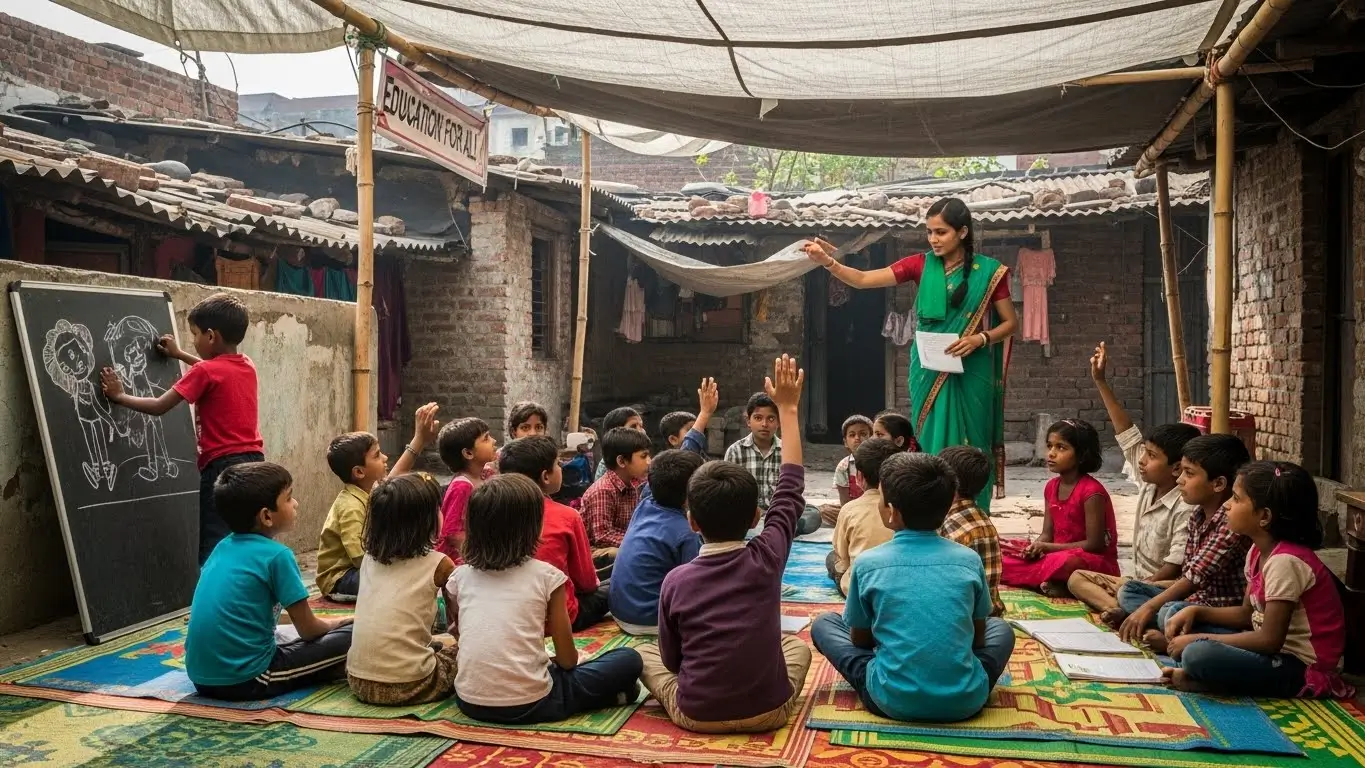
Delhi grows in two different directions at the same time. On one side you see tall buildings, metro lines, new offices and people rushing to work. On the other side, there are narrow lanes where families struggle daily for food, rent and basic survival. In these areas, education becomes a luxury. Not because parents don’t value it, but because life is already heavy for them.
This is where NGOs step in. Their work is not loud or showy. It starts quietly inside small rooms, community centres and even open spaces inside slums. The goal is simple: give every child a chance to learn.
Taking classrooms inside slums
A big problem for children in slum areas is distance. Many can’t travel far for school. Some don’t have proper documents for admission. Some parents worry about safety. NGOs bridge this gap by running classes directly in the community. A small room becomes a classroom. A volunteer becomes a teacher. Slowly children start coming regularly and get used to studying.
Training people from the same community
One thing that actually works well is involving local women. NGOs train them to teach basic subjects. These women know the area and understand the families. Children listen to them and feel safe. Parents trust them. This builds a natural connection and makes learning easier.
Flexible timing for real-life situations
It’s common for children in slums to help at home or work part time. Because of this, regular school hours don’t work for them. NGOs arrange morning batches, evening classes and weekend learning sessions. Some even offer short bridge courses where children catch up with basics and later enter regular schools. This flexibility is what keeps many children connected to education.
Guiding families with documents and school admissions
Many parents want their children to study but don’t know how to start the process. They get confused with forms, documents and requirements. NGOs help families complete paperwork, find nearby schools and understand government schemes. Without this guidance, many children simply stay out of school.
Supporting kids with books and essentials
For families living in slums, even buying notebooks and uniforms is a big burden. NGO centres provide basic study materials, school bags, stationery and sometimes snacks. This small support removes a big barrier and helps children focus on learning instead of worrying about expenses.
The emotional side of learning
A lot of children in slum communities deal with stress, unstable environments or family issues. NGOs give them a safe space where they feel seen and heard. Teachers talk to them, encourage them and help them believe in themselves. This emotional support is as important as academics.
SK Vision’s work in this space
SK Vision Foundation is one of the organisations working with this approach. Their initiative to provide free education to underprivileged children started with a Free learning centre in Nathupur, Gurgaon where around seventy children enrolled. The idea is simple and practical: offer education without making it complicated or costly for families. Along with learning support, SK Vision also focuses on health and community welfare, which strengthens the overall environment around the child. More details about their work can be found here https://skvision.org
Why this effort matters
Education is not just about books. It changes how a child sees the world. It gives them confidence. It gives them choices. A child who grows up in a slum often feels restricted by their surroundings. A small learning centre inside their lane becomes the place where they start thinking differently.
Once a child becomes a first-generation learner, the entire family benefits. Over time, the whole community becomes stronger.
The impact may look small, but it is real
Each child attending an NGO centre today is a step towards a more equal future. The change is slow but steady. Most of these organisations work quietly, without seeking attention, but their impact will be felt for years.
NGOs, volunteers and local teachers together are building a foundation that gives children from slum areas a real shot at life. And that alone makes their work meaningful.